
Vietnam 1st Battalion
Screaming Eagles and The Battle for Mother’s Day Hill
By Don Kochi
When we think of the 101st Airborne Division in Vietnam, the battle for Hamburger Hill (Hill 937) seem synonymous in many people’s mind to have been the singular defining combat event for the Screaming Eagles. A costly human meat grinder in casualty numbers, yes, but one occurring late (1969) in the division’s Vietnam chronology. It was far back as 1965 when a piecemeal element of the division was first deployed to South Vietnam as part of the initial expeditionary effort to suppress the growing communist insurgency. Soon upon arrival the Eagles found themselves locked in heavy engagements fighting the Viet-Cong and North Vietnamese Army (PAVN).
Referred by several names, ‘Always-First Brigade’, ‘Nomads of Vietnam’, and ‘Eagle’s Brigade’, the 1st Brigade (Separate) of the 101st Airborne Division arrived at Bien Hoa/Vung Tau in July of 1965 and was immediately dispatched to II Corps (RVN) as their tactical area of responsibility (TAOR). Operating out of Camp Eagle’s Roost at Phan Rang, units of the 1st Brigade (Sep.) assisted in the pacification of Phu Yen Province and experienced heavy combat action near Kontum. At the time, the 1st Brigade’s table of organization consisted of three frontline maneuver battalions; the 1st and 2nd Battalions, 327th Infantry (Airborne) and the 2nd Battalion, 502nd Infantry (Airborne). Making-up the Brigade’s both assigned and attached organic assets were; the 2nd BN of 320th Artillery (ABN), A Co. of 326th Engineers BN (ABN), D Co. of 326th Medical BN. (ABN), and B. Co. of 501st Signal BN (ABN). Note that the supporting units were all airborne-qualified. All personnel assigned to the 101st Airborne Division had to be a bona fide paratrooper wearing their hard-earned jump wings. However with the increasing dependency on the helicopter as the primary assault vehicle in Vietnam, the famed Screaming Eagle Division sadly lost their ‘jump-status’ by August 26, 1968 and was reconfigured into an air-assault airmobile division which as it remains to this day.
In April 1967, Task Force OREGON a provisional division-sized command was formed to neutralize enemy activity in the Quang Ngai Province. Its secondary role was to relieve U.S. Marines units in the area permitting their movement further northwards to the DMZ vicinity to stem the growing NVA pressure. Additionally the task force freed the 1st Cavalry Division (Airmobile) to move their operations further west and southwest into the mountainous Central Highlands where their tactical air mobility gave them a distinct advantage. The three combat brigades constituting Task Force OREGON were the 3rd Brigade, 25th Infantry Division, the 196th (Light) Infantry Brigade, and the 1st Brigade (Separate) of the 101st Airborne Division.
Directed by USARVN Headquarters and OPCON TF OREGON, the 1st Brigade (Sep.) 101st ABN DIV was assigned the Song Tra Cau Valley and western Ba To District vicinity (Quang Ngai Province, I Corps) as their primary tactical area of responsibility (TAOR) for their next operation. The airborne brigade was to conduct a series of search and destroy operations to find, fix, and destroy residing VC/NVA forces and weapons caches as well as eliminate their base camps found in sectors west and northwest of Duc Pho. The mission nomenclature given for this rather optimistic campaigning was ‘Operation MALHEUR’, with Phase I commencing on May 11, 1967 (and terminating on June 8, 1967).
In preparation, from May 1st to May 6th 1967, the brigade began effecting movement to Duc Pho from their main home base at Camp Eagle’s Roost in Phan Rang. The first stage consisted of truck convoys up to Nha Trang, and was followed by a seaborne stage of LST ships transporting most of the brigade from Nha Trang to Duc Pho on the final northward leg. By May 8, 1967, all three combat maneuver battalions were firmly ensconced at CARENTAN Base, the brigade’s forward base camp at Duc Pho. It was about this time a young paratrooper, PFC Michael E. Peterson joined the brigade as one of several new replacement ‘cherries’ replenishing the depleted ranks for the upcoming operation.
A 19-year old draftee from Monrovia, California, Michael Peterson entered US Army basic training at Fort Ord, Calif., sometimes in mid-1966. Graduating with 2nd Platoon, B Company, 5th Battalion, Basic Combat Training (BCT) 3rd Brigade (fig. 1), this infantry training virtually sealed a guarantee tour-of-duty in South Vietnam.
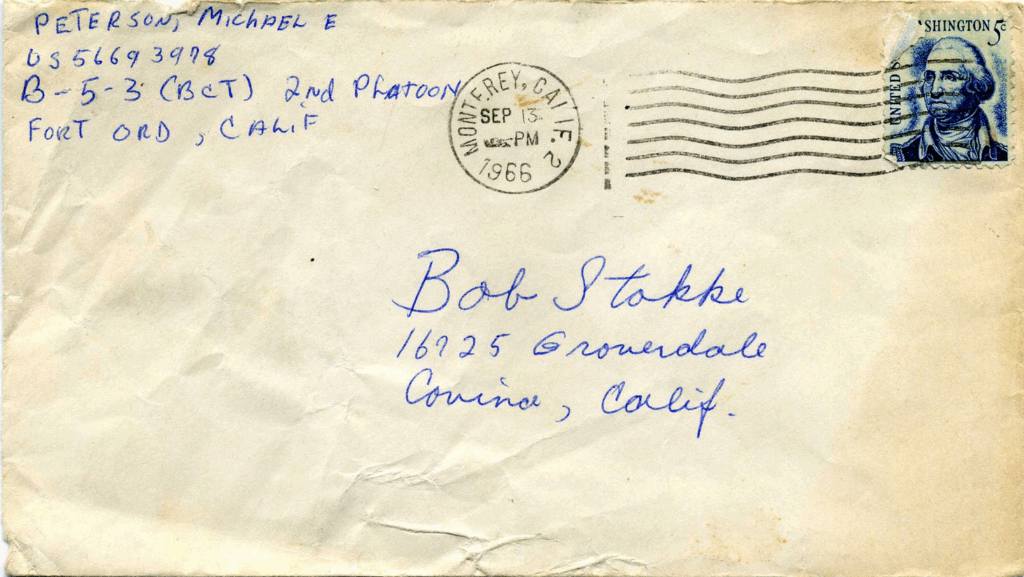
The contents of a letter written to his boyhood friend is revealing of the Army’s ramped-up training to meet manpower demands for a growing conflict in Southeast Asia. Postdated 13 SEPT 1966 with a Monterey CALIF. cancellation (fig. 2), it said in part:
Click to enlarge
“….Sorry I’ve taken so long to write, but I’ve been pretty busy lately. They keep us going from 5AM to 9:30PM. We do a lot of physical training that’s really hard. We got our M-14 rifles the other day and learned how to take them apart and clean them and put them back together again. I can hardly wait to start shooting them. All they do around here is yell at you. We’ve been having a lot of talks and films on guerrilla warfare and counterinsurgency. If you don’t know what that means, ask your dad. I signed up to go into the paratroopers but I might not get it. They said they can only take about three out of our company. Well, it’s almost time for light out, so I better sign off…”
Click to enlarge
Apparently he was successful in wrangling a limited jump-school slot at Fort Benning, Georgia, where he proudly earned his US Army Parachutist Qualification wings (fig. 3a and fig. 3b). Finishing his advanced infantry training, Peterson’s military occupational specialty (MOS) is listed on his service records, as 11C1P, Indirect Fire Infantryman Airborne-qualified. Next stop, an one-year combat tour in the Republic of Vietnam.